


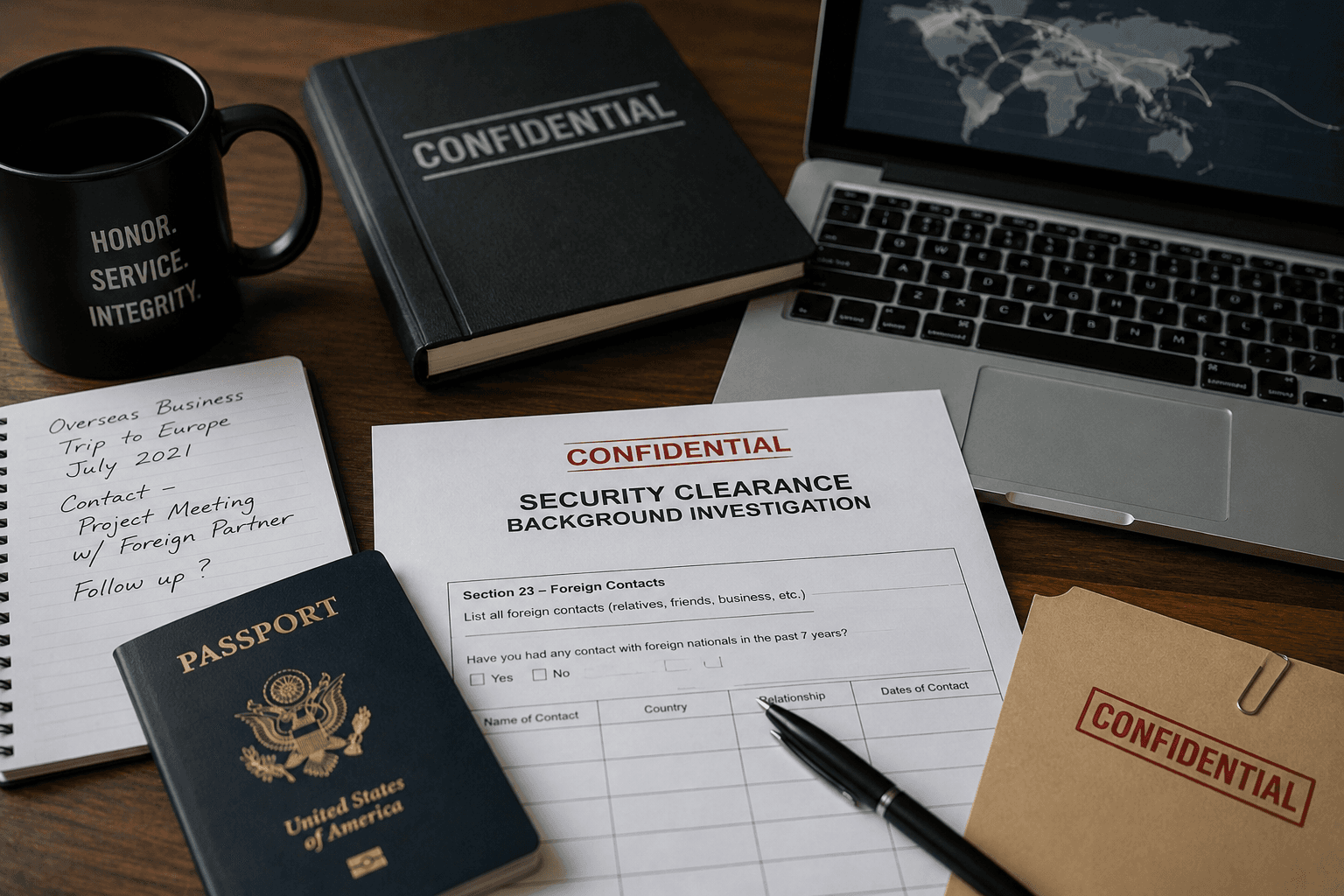
What Happens If You Fail to Report Foreign Contact on a Security Clearance?

At Military Defender, one of the most common security clearance issues we see involves foreign contacts that were never reported. In many situations, service members or clearance holders do not intentionally hide the relationship—they simply misunderstand what must be disclosed or assume the connection is not important.
Unfortunately, the government often sees the situation differently.
When foreign contacts are not properly reported, the issue is rarely just about the relationship itself. Instead, investigators and adjudicators may begin questioning a person’s honesty, reliability, judgment, and willingness to follow reporting requirements. In many cases, the failure to report becomes more serious than the foreign contact itself.
Understanding how foreign contact rules work is critical for anyone holding—or seeking—a security clearance.
What Is Considered a Foreign Contact?
A foreign contact generally refers to a relationship or ongoing interaction with a non-U.S. citizen that could create a potential security concern.
This may include:
- Friends living overseas
- Romantic relationships with foreign nationals
- Business relationships
- Frequent communication with individuals outside the United States
- Foreign family members
- Online relationships developed through social media or gaming platforms
Not every foreign contact is a problem. However, some relationships must be disclosed depending on the nature, frequency, and closeness of the interaction.
Why the Government Requires Reporting
Security clearance rules are designed to identify potential vulnerabilities that could expose someone to:
- Foreign influence
- Coercion or manipulation
- Exploitation
- Conflicts of interest
The government wants to ensure that individuals with access to classified information are transparent about relationships that could create risk.
The issue is not necessarily having foreign contacts—it is failing to disclose them properly.
When You Are Required to Report Foreign Contacts
Reporting requirements can vary depending on:
- Your agency
- Clearance level
- Specific job responsibilities
However, in general, you may need to report:
- Close and continuing contact with foreign nationals
- Foreign romantic relationships
- Foreign financial interests
- Foreign travel in certain circumstances
- Contact involving sensitive countries or governments
Many people mistakenly believe casual or online relationships do not count. In reality, repeated digital communication may still raise reporting obligations.
How Unreported Foreign Contact Is Discovered
Many individuals assume the government will never know about unreported relationships. In practice, foreign contacts are often discovered through:
- Background investigations
- Polygraph examinations
- Social media reviews
- Financial records
- Travel history
- Interviews with coworkers, friends, or family
- Continuous Vetting systems
Sometimes the issue arises years after the relationship began.
Why Failure to Report Creates Bigger Problems
In many security clearance cases, the government is less concerned about the foreign contact itself than about the failure to disclose it.
Adjudicators may ask:
- Why was the relationship hidden?
- Was the omission intentional?
- What else may not have been disclosed?
- Can the individual be trusted moving forward?
Once honesty becomes part of the concern, the situation becomes significantly more serious.
Common Situations That Lead to Problems
At Military Defender, we frequently see situations involving:
- Long-distance romantic relationships
- Online gaming friendships
- Social media communication with foreign nationals
- Foreign-born relatives not disclosed properly
- Overseas business relationships
- Repeated travel tied to personal relationships
In many cases, the individual never realized the relationship required reporting.
Can Online Relationships Count as Foreign Contact?
Yes. This is becoming increasingly common.
Foreign contact concerns may arise from:
- Social media relationships
- Messaging apps
- Online gaming communities
- Professional networking platforms
- Dating apps
Even if the relationship never becomes in-person, repeated and meaningful communication can still trigger reporting obligations.
How Unreported Foreign Contact Affects Security Clearance
If concerns arise, possible consequences include:
- Additional investigation
- Security clearance suspension
- Statement of Reasons (SOR)
- Clearance denial or revocation
The outcome often depends on:
- The nature of the relationship
- Whether the omission was intentional
- The individual’s response once questioned
- Evidence of mitigation
The government evaluates the “whole person,” but honesty plays a major role.
What to Do If You Failed to Report a Foreign Contact
If you realize that you failed to disclose a reportable relationship, taking proactive action is often important.
Key steps may include:
- Reviewing reporting requirements carefully
- Gathering accurate details about the relationship
- Avoiding inconsistent explanations
- Being truthful and transparent
- Seeking legal guidance before making statements in serious situations
Attempting to hide or minimize the issue usually makes things worse.
Common Mistakes People Make
Many clearance holders unintentionally damage their position by:
- Providing incomplete explanations
- Changing their story later
- Deleting communications or messages
- Assuming the issue is too small to matter
- Waiting until confronted before addressing the problem
These actions can increase concerns about credibility and judgment.
The Role of Mitigation
Even serious reporting issues can sometimes be mitigated.
Mitigating factors may include:
- Lack of intent to conceal
- Limited nature of the contact
- Voluntary self-reporting
- Evidence of honesty and cooperation
- Clear corrective actions taken
Demonstrating transparency and responsibility can significantly improve the situation.
How Continuous Vetting Has Changed the Process
Under modern Continuous Vetting (CV) systems, the government can identify issues more quickly than in the past.
This means concerns involving:
- Foreign travel
- International communication
- Financial activity
- Digital behavior
may surface sooner and more frequently.
Clearance holders today face much greater visibility than they did years ago.
Why Legal Guidance Can Be Critical
Foreign contact cases can become complex very quickly—especially when investigators begin focusing on honesty and disclosure.
An experienced security clearance attorney can help:
- Evaluate the seriousness of the issue
- Identify mitigation strategies
- Prepare accurate responses
- Prevent avoidable mistakes
- Protect your clearance eligibility and career
Early action often makes a major difference.
How Military Defender Helps Clients Protect Their Clearance
At Military Defender, we understand that many foreign contact issues begin with misunderstanding—not bad intent. Unfortunately, even honest mistakes can create major clearance concerns if handled improperly.
We work with clients to evaluate their situation, develop strategic responses, and address concerns before they escalate into clearance suspension or revocation.
Protect Your Clearance Before the Situation Escalates
If you failed to report a foreign contact—or believe investigators may have questions about your relationships or communications—it is important to act carefully and strategically.
The earlier you address the issue, the better your chances of protecting your clearance and your future.
Contact Military Defender today to discuss your situation and take proactive steps to protect your security clearance, career, and reputation.
contact us
Take Command of Your Defense
Fill out the short form below and let our military law experts stand by your side in the fight for justice.