


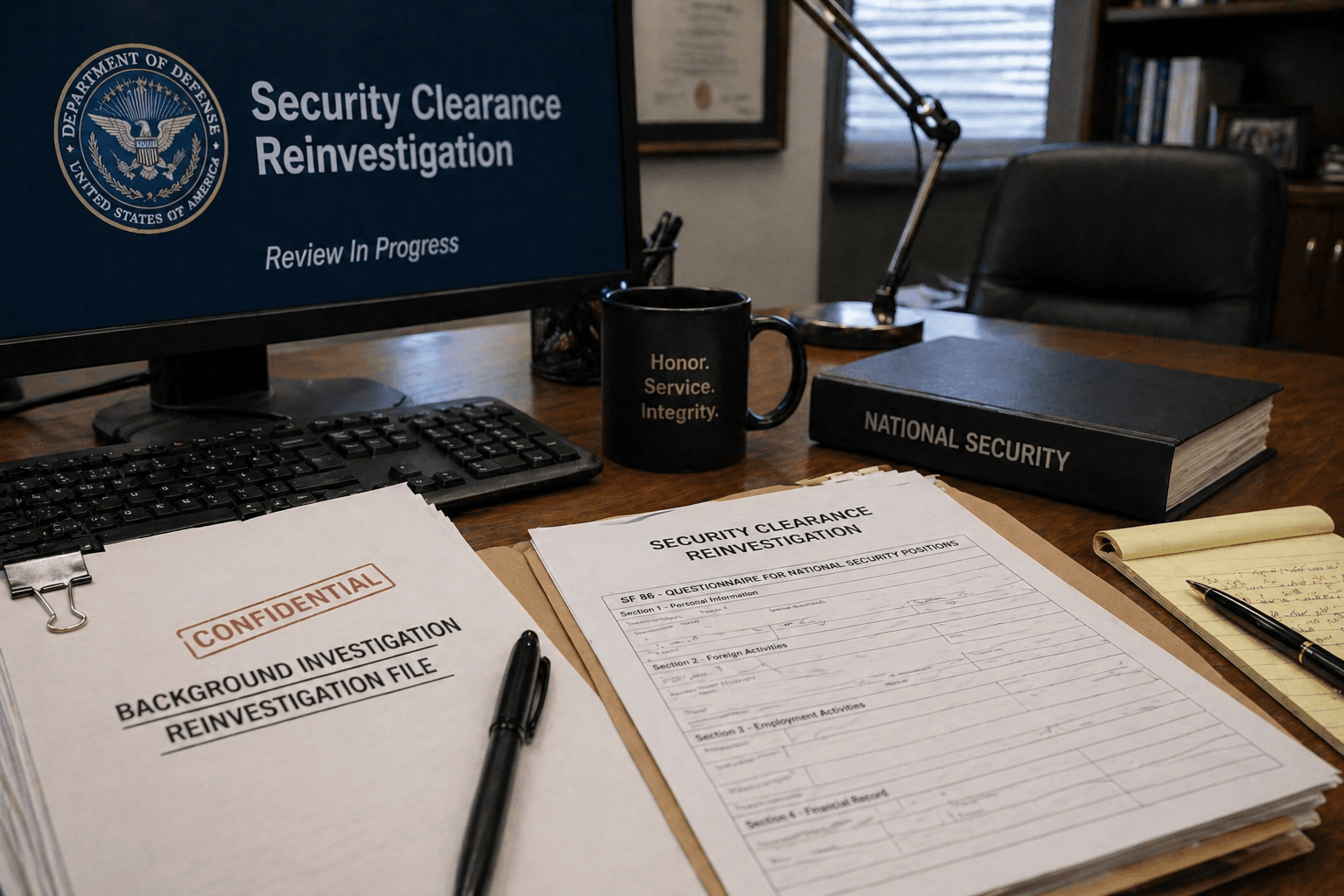
What Is a Security Clearance Reinvestigation and Why Does It Matter?

At Military Defender, many service members and defense professionals believe that once they obtain a security clearance, they are “in the clear” indefinitely. Unfortunately, that is not the case. One of the most overlooked risks to a clearance is the security clearance reinvestigation process.
A reinvestigation can occur years after your initial approval—and it can lead to unexpected issues, even for individuals who have maintained a strong record. Understanding how reinvestigations work and what triggers them is essential to protecting your clearance and your career.
What Is a Security Clearance Reinvestigation?
A security clearance reinvestigation is a periodic review of your background conducted after your initial clearance has already been granted.
The purpose is to ensure that you continue to meet the standards of:
- Trustworthiness
- Reliability
- Loyalty to the United States
Clearances are not permanent approvals—they are continuously evaluated over time.
Why Reinvestigations Happen
The government requires reinvestigations because circumstances can change. A person who was fully qualified five years ago may now present new concerns.
Reinvestigations help identify:
- Changes in financial status
- New criminal or legal issues
- Undisclosed foreign contacts
- Personal conduct concerns
- Security violations
This process ensures that individuals with access to sensitive information remain eligible.
How Often Do Reinvestigations Occur?
The frequency of reinvestigations depends on the level of clearance.
Generally:
- Top Secret Clearance → Every 5 years
- Secret Clearance → Every 10 years
- Confidential Clearance → Every 15 years
However, under newer systems like Continuous Vetting (CV), monitoring may occur more regularly—even outside these timelines.
What Is Continuous Vetting?
Continuous Vetting is a system that allows the government to monitor clearance holders in real time, rather than waiting for scheduled reinvestigations.
This may include checks on:
- Criminal records
- Financial activity
- Security databases
- Travel patterns
This means issues can be flagged as they happen, not just during periodic reviews.
What Happens During a Reinvestigation
A reinvestigation may involve a variety of checks and updates.
These can include:
- Updating your security questionnaire (SF-86)
- Reviewing financial and legal records
- Verifying employment history
- Conducting interviews with you and references
- Reviewing travel and foreign contacts
In some cases, you may be interviewed directly by an investigator.
Common Issues That Arise During Reinvestigations
Many service members are surprised to learn that issues developed over time can trigger concerns during reinvestigation.
Common problems include:
- Financial difficulties (debt, collections, bankruptcy)
- Failure to report foreign contacts
- Legal issues or arrests
- Inconsistencies in previous disclosures
- Security violations
- Personal conduct concerns
Even small issues can raise questions if not properly explained.
Why Past Mistakes Can Resurface
One important aspect of reinvestigations is that past issues may be reexamined.
For example:
- Information that was previously overlooked may be reviewed again
- Inconsistencies between past and current disclosures may be identified
- Patterns of behavior may become more apparent over time
This is why consistency and honesty are critical.
What Happens If Concerns Are Identified
If issues are found during a reinvestigation, several things may happen.
Possible outcomes include:
- Request for additional information
- Security clearance suspension
- Issuance of a Statement of Reasons (SOR)
- Revocation of clearance
The severity depends on the nature of the concern and whether it can be mitigated.
How Reinvestigations Affect Your Career
Because many military and defense roles depend on clearance eligibility, reinvestigations can have immediate consequences.
Potential impacts include:
- Temporary loss of access to classified systems
- Job reassignment
- Delay in promotions
- Increased scrutiny from leadership
- Career uncertainty
In some cases, clearance issues can lead to separation from service.
Common Mistakes During Reinvestigation
Service members often make avoidable mistakes when going through reinvestigation.
Common errors include:
- Failing to disclose required information
- Minimizing financial or legal issues
- Providing inconsistent answers
- Waiting too long to address problems
- Assuming minor issues do not matter
These mistakes can significantly increase risk.
How to Prepare for a Reinvestigation
Preparation can make a major difference in how smoothly the process goes.
Key steps include:
- Reviewing your previous SF-86 for consistency
- Gathering accurate financial and legal records
- Being honest and thorough in disclosures
- Addressing any outstanding issues proactively
- Keeping records of foreign contacts and travel
Being proactive demonstrates responsibility and reliability.
The Role of Mitigation
One of the most important factors in clearance decisions is mitigation.
You may still maintain your clearance if you can show:
- The issue has been resolved
- You are taking corrective action
- The problem is unlikely to recur
- You are trustworthy moving forward
Clearance decisions are based on the whole person concept.
Why Legal Guidance Can Be Critical
If issues arise during a reinvestigation, it is important to act quickly and strategically.
An experienced attorney can help:
- Evaluate potential risks
- Prepare responses to concerns
- Address inconsistencies
- Develop mitigation strategies
- Protect your clearance eligibility
Early action can prevent escalation.
How Military Defender Supports Clients
At Military Defender, we understand that reinvestigations can feel routine—until something goes wrong. Many clients come to us after unexpected concerns arise during what they thought would be a simple review.
We help clients identify risks early, respond effectively, and protect their clearance and career. Our goal is to prevent minor issues from becoming major problems.
Protect Your Clearance Before Issues Escalate
If you are approaching a reinvestigation or have already been notified of concerns, it is important to take action now. The earlier you address potential issues, the better your chances of protecting your clearance.
Contact Military Defender today to discuss your situation and take proactive steps to protect your security clearance and your future.
contact us
Take Command of Your Defense
Fill out the short form below and let our military law experts stand by your side in the fight for justice.