


What Is a Security Clearance Statement of Reasons (SOR) and How Should You Respond?

At Military Defender, one of the most critical moments in a security clearance case is when a service member or federal employee receives a Statement of Reasons (SOR). For many, this document comes as a shock—and often signals that their clearance is at serious risk.
An SOR is not just a notice. It is a formal document outlining the government’s concerns about your eligibility to hold a security clearance. How you respond to it can determine whether you keep your clearance—or lose it entirely.
Understanding what an SOR is and how to approach it strategically is essential.
What Is a Statement of Reasons (SOR)?
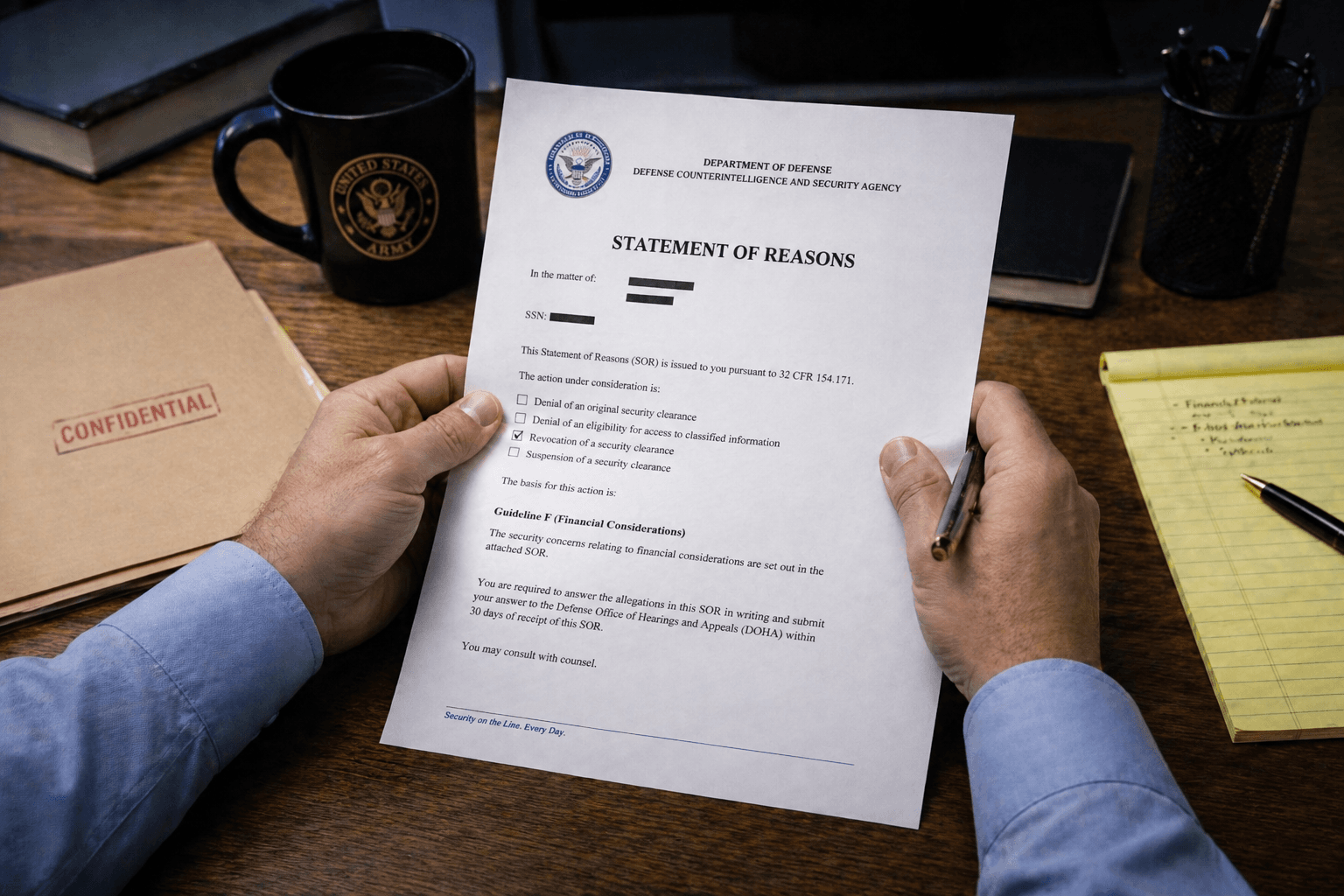
A Statement of Reasons (SOR) is an official document issued by the government explaining why it is considering denying or revoking your security clearance.
The SOR outlines:
- Specific concerns about your background
- The guidelines those concerns fall under
- The factual basis for the concerns
It is essentially the government’s case against your eligibility for access to classified information.
Why You Might Receive an SOR
An SOR is typically issued after a background investigation or review identifies potential security concerns.
Common reasons include:
- Financial problems or excessive debt
- Criminal conduct or legal issues
- Drug or alcohol involvement
- Foreign contacts or influence
- Personal conduct concerns (honesty, omissions, etc.)
- Security violations
The presence of these issues does not automatically disqualify you—but they must be addressed.
What the SOR Means for Your Clearance
Receiving an SOR means your clearance is at risk, but it has not yet been revoked.
At this stage:
- No final decision has been made
- You have the opportunity to respond
- The government is requesting your explanation
This is your chance to present your side of the story.
The Importance of Your Response
Your response to the SOR is one of the most important steps in the entire process.
A strong response can:
- Address each allegation directly
- Provide context and clarification
- Demonstrate mitigation
- Show reliability and good judgment
- Preserve your eligibility for clearance
A weak or incomplete response, however, can lead to denial or revocation.
How to Respond to an SOR
Responding to an SOR requires more than simply denying the allegations. It requires a structured and strategic approach.
A proper response should:
- Address each concern individually
- Include supporting documentation
- Provide clear explanations
- Demonstrate corrective actions
- Show consistency and honesty
This is not just about telling your story—it’s about proving your reliability.
Common Mistakes to Avoid
Many individuals make critical errors when responding to an SOR, often due to stress or misunderstanding.
Avoid:
- Ignoring certain allegations
- Providing vague or emotional responses
- Failing to include documentation
- Contradicting previous statements
- Missing deadlines
Each of these mistakes can weaken your case significantly.
What Happens After You Submit Your Response
After your response is submitted, the case will be reviewed by adjudicators.
Possible outcomes include:
- Clearance is granted or reinstated
- Additional information is requested
- Case proceeds to a hearing
- Clearance is denied or revoked
In some cases, you may have the opportunity to present your case before an administrative judge.
The Role of Mitigation in SOR Cases
One of the most important aspects of responding to an SOR is demonstrating mitigation.
Mitigation means showing that:
- The issue is no longer a concern
- The behavior has been corrected
- It is unlikely to happen again
- You can be trusted moving forward
Examples include:
- Paying off debts
- Completing counseling programs
- Providing character references
- Demonstrating consistent responsible behavior
The government evaluates the “whole person” when making decisions.
How an SOR Impacts Your Career
A pending SOR can affect your professional life even before a final decision is made.
Possible impacts include:
- Suspension of clearance access
- Job reassignment or removal
- Loss of responsibilities
- Career uncertainty
If the clearance is revoked, the impact can be long-term or permanent.
Why Timing Is Critical
When you receive an SOR, you typically have a limited amount of time to respond—often 20 to 30 days.
This timeline makes it critical to:
- Act quickly
- Gather documentation
- Develop a strategy
- Avoid rushed or incomplete responses
Delaying action can significantly reduce your chances of success.
How Legal Guidance Can Strengthen Your Case
An SOR response is not just a form—it is a legal argument.
An experienced attorney can help:
- Analyze the allegations
- Identify the strongest defenses
- Organize supporting evidence
- Draft a persuasive response
- Prepare for possible hearings
Professional guidance can make a major difference in the outcome.
How Military Defender Supports Clients Facing SORs
At Military Defender, we understand how overwhelming it can be to receive a Statement of Reasons. Many clients come to us unsure how serious the situation is or how to respond effectively.
We work closely with clients to build strong, strategic responses designed to address concerns, demonstrate mitigation, and protect their clearance eligibility.
Protect Your Clearance Before It Is Too Late
If you have received a Statement of Reasons, time is critical. The way you respond can determine whether you keep your clearance—or lose it.
Contact Military Defender today to discuss your situation and take proactive steps to protect your security clearance and your future.
contact us
Take Command of Your Defense
Fill out the short form below and let our military law experts stand by your side in the fight for justice.